Weight Gain After Marriage: The Science Behind Why It Happens

Reviewed by Dr. Sana Afreen, PhD
· 2 min read
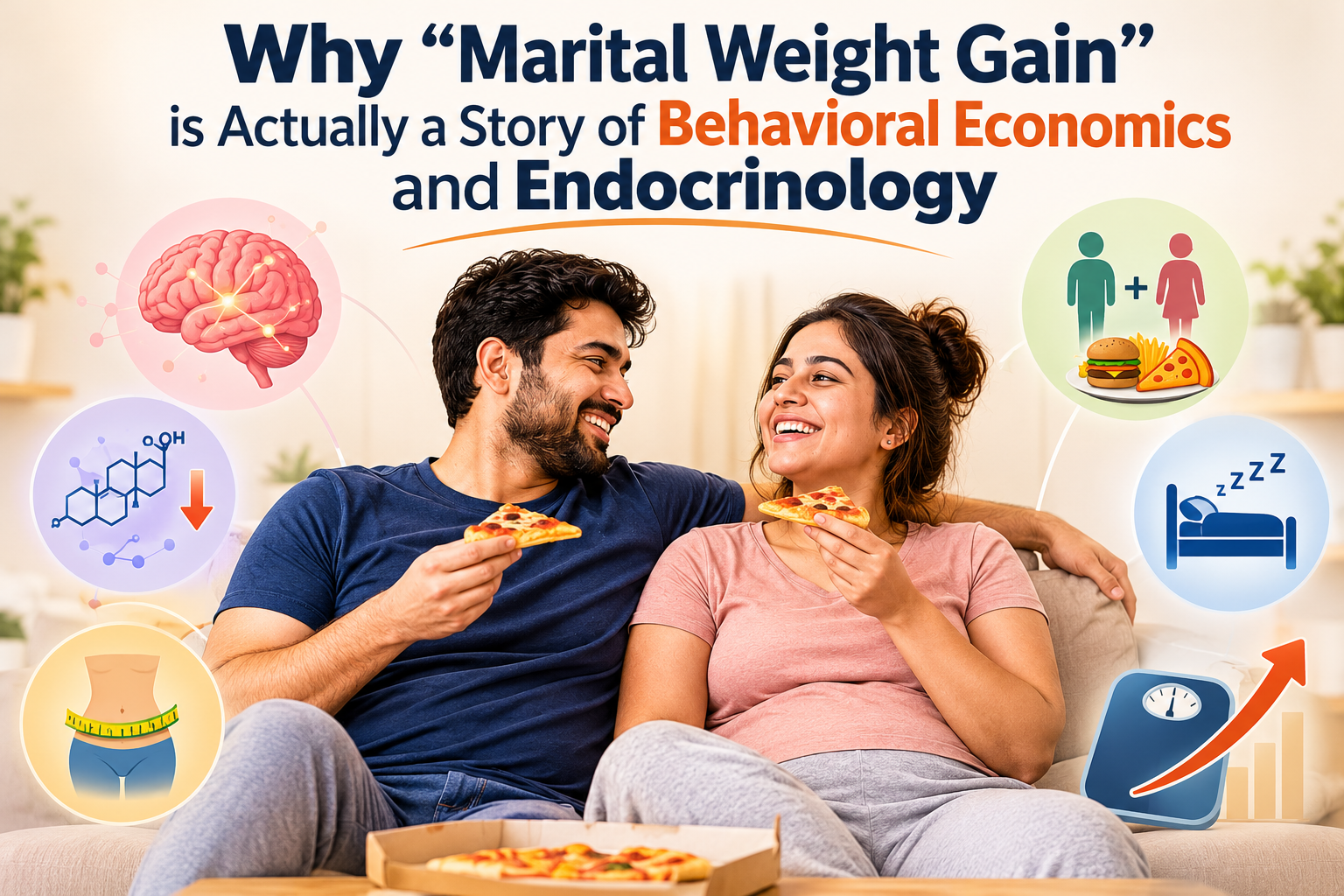
Weight Gain After Marriage: The Science Behind Why It Happens
When people say, "You’ll put on weight after marriage," it's usually dismissed as a cliché or a sign of "letting oneself go."
But if you look at the clinical and sociological data, it's actually a fascinating case study in how our environment dictates our biology.
Far from a mere lack of discipline, transitioning into a long-term, cohabiting partnership fundamentally alters both the psychological architecture and the neuroendocrine pathways that govern energy balance.
Why Do People Gain Weight After Marriage?
Here is what is actually happening beneath the surface:
1. The Behavioral Convergence Trap
When two independent routines merge into one domestic unit, eating habits homogenize. From a portion-size perspective, this often introduces "portion distortion"—particularly for the partner with lower baseline metabolic needs who begins matching their partner’s caloric intake. Mealtime transitions from functional refueling into a primary social and leisure activity.
2. The Testosterone Shift (The "Settling" Hormone)
Evolutionary biology and longitudinal endocrine data show that entering a secure, long-term partnership triggers a significant drop in baseline testosterone in both men and women. Because testosterone is highly anabolic (maintaining lean muscle mass and inhibiting fat cell formation), a downward shift can subtly alter the body's muscle-to-fat ratio and decrease basal metabolic rate (BMR).
3. Down-Regulation of the HPA Axis
A stable, happy marriage acts as a massive psychological safety signal, lowering chronic cortisol (the stress hormone). While great for systemic health, the hyper-vigilant, high-stress state of single life often suppresses appetite or leads to accidental caloric deficits. Switching to a dominant parasympathetic ("rest and digest") state naturally improves nutrient absorption and stimulates appetite.
4. Circadian and Appetite Hormone Disruption
Sharing a bed means synchronizing circadian rhythms. When partners have mismatched chronotypes (a night owl vs. an early bird), it frequently leads to sub-clinical sleep fragmentation. Just minor sleep disruptions alter the nocturnal secretion of leptin (the satiety hormone) and ghrelin (the hunger hormone), driving subconscious cravings for calorie-dense carbohydrates the next day.
The Takeaway?
Our bodies are highly adaptive survival machines. The transition into marriage is a physiological shift from a high-vigilance state optimized for competition and acquisition, to a conservation state optimized for bonding and recovery.
Understanding the underlying biochemistry means we can stop viewing health through the reductive lens of "willpower" and start designing better domestic environments to support our long-term wellness goals.
This article is for general education. It does not replace advice from your doctor. If you have a medical condition or take medicines, speak to your doctor before changing your diet.